
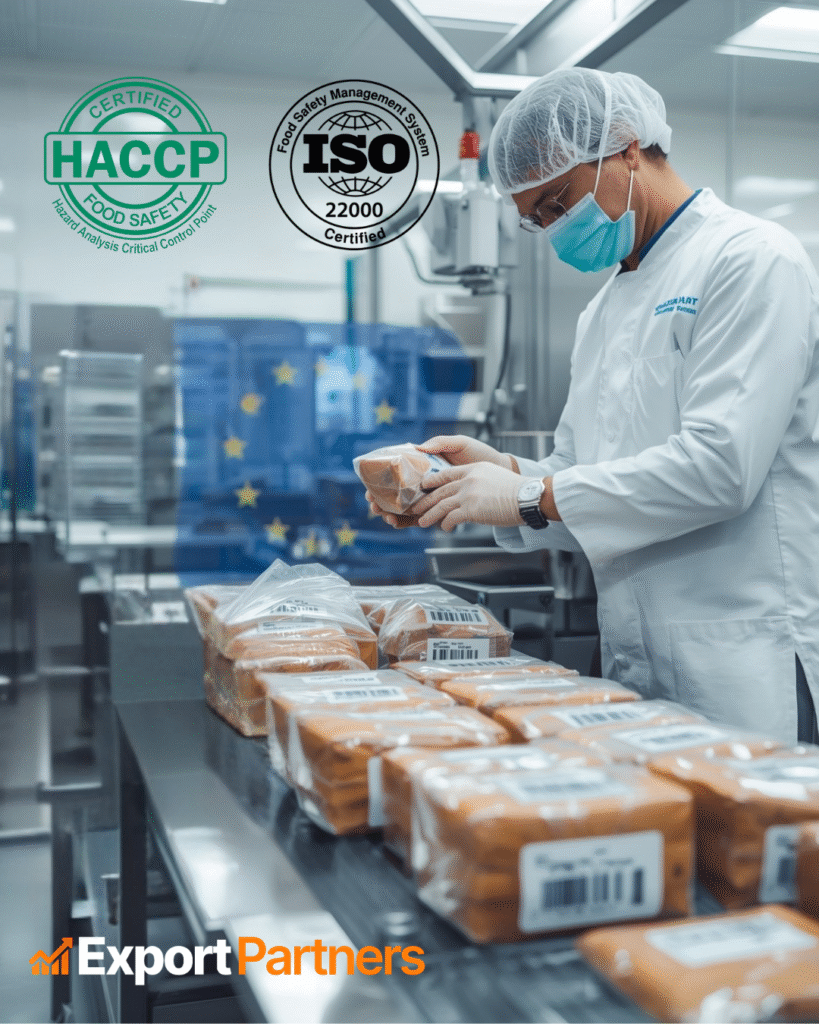
Food exports to Europe represent a market for Turkish producers that is both high-volume and highly regulated. Products intended for sale in countries such as Germany, the Netherlands, France, Austria, and Belgium must meet specific documentation and standards requirements, both during production and throughout the supply chain.
This article addresses the documentation requirements in order: which documents are mandatory, which are requested by the recipient, and which are required only in certain countries. The distinction is important because trying to obtain all of them at once can unnecessarily prolong the process.
Essential Steps for Exporting Food to Europe
If a food manufacturer operating in Turkey wants to sell its products in Europe, the basic steps are as follows:
- Food Business Registration or Approval Certificate (Ministry of Agriculture and Forestry)
- Production infrastructure compliant with the Turkish Food Codex
- Product labels, ingredient lists, and allergen disclosures in compliance with EU regulations
- When required, importer labeling—that is, the importer’s information on the label
- Translated technical documents (table of contents, nutritional information)
Proceeding to the certification process before these five steps are completed is often counterproductive, because the audit also examines the production infrastructure.
What is an HACCP certificate, and why is it required for food exports to Europe?
HACCP (Hazard Analysis and Critical Control Points), or "Hazard Analysis and Critical Control Points" in Turkish. A system for hygiene, process safety, and risk prevention in food production.
The basis for this requirement is clear: Article 5, Paragraph 1 of EU Regulation No. 852/2004 requires food business operators to establish, implement, and maintain a permanent procedure based on HACCP principles. The consolidated version of the Regulation is dated March 24, 2021, and is currently in force. According to paragraph 3 of the article, this obligation applies to operations following primary production.
In practice, there are two separate requests, and it’s important not to confuse them:
- Having the system in place is what the regulations require. The auditor wants to see that the system is actually functioning, not just the document itself.
- Certification, on the other hand, is often required by the buyer and the marketplace. Amazon’s requirement to upload documents in its European food categories is the most visible example of this requirement.
Under the HACCP system, the producer identifies, controls, and documents at which stages microbiological, chemical, or physical risks may arise. In Turkey, certification is typically obtained as part of the ISO 22000 system.
Source: TSE, TS EN ISO 22000 Food Safety Management System
The Difference Between HACCP and ISO 22000
| HACCP | ISO 22000 | |
|---|---|---|
| What it is | A system and method | The international standard covering this system |
| Scope | Food Safety Risk Control | Quality management combined with risk control |
| For Europe | As a first step, this is usually sufficient | It can be a factor in a corporate buyer’s decision |
ISO 22000 is based on HACCP. HACCP is generally sufficient for entering the European market initially, while ISO 22000 can be a distinguishing factor in negotiations with supermarket chains and major distributors.
Other documents frequently requested in Europe
- ISO 22000 Food Safety Management System Certification
- GMP (Good Manufacturing Practices) certification. For details, see our article on how to obtain a GMP certificate.
- Consumer labels such as "halal," "organic," and "vegan" vary depending on the country where they are required
- Laboratory analysis reports: microbiological, chemical, and pesticide residue
- Product label compliance report, in accordance with the target country's language and content regulations
- LUCID registration is required for packaging declarations in Germany. For more details, see our article on Amazon Germany FBA private label.
- GTIN and barcode information for traceability
Additional requirements if you plan to sell through an e-commerce channel
If the product will be sold on Amazon, Etsy, or your own website, three additional headings are added:
- Application and Document Upload for the Amazon Europe Food Category
- A CE certificate is not required for food products, but compliance with standards such as EN 1186 may be required for packaging materials. If you’re curious about the CE aspect, you can also check out our article titled “What Is a CE Certificate? ”
- EORI and VAT numbers. Our article on the customs process in Germany provides details for customs authorities.
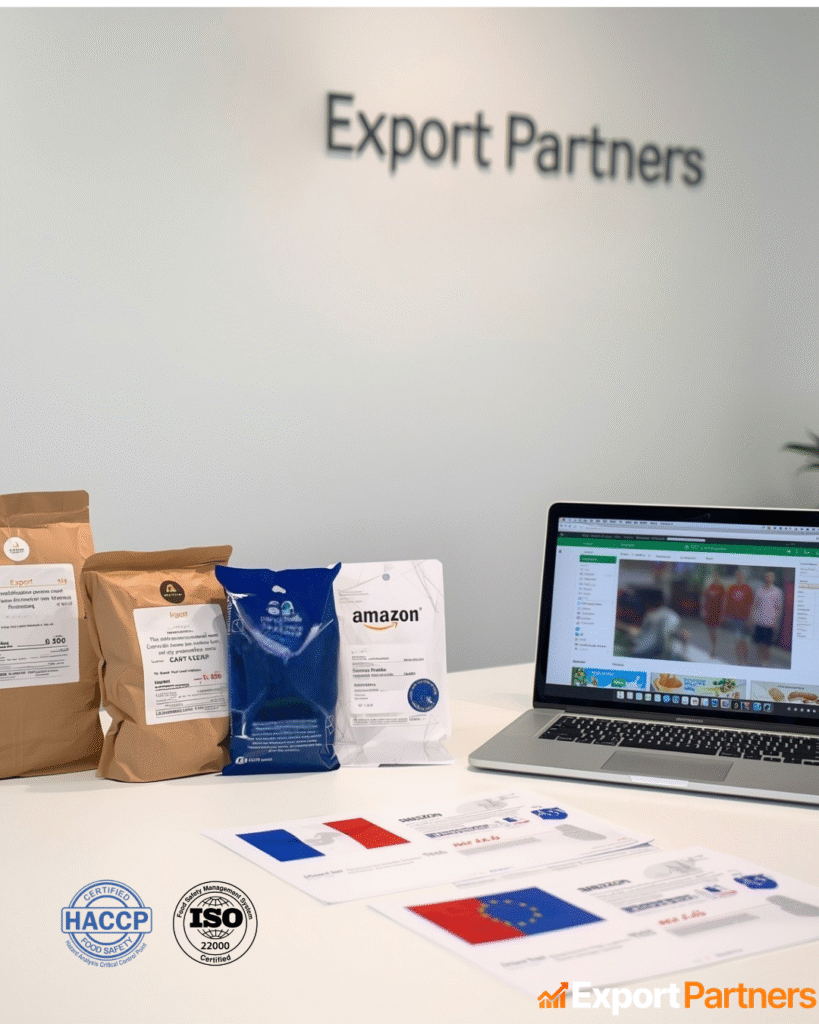
How is the process proceeding on the Turkish side?
The documentation process is divided into four separate tasks, which can be carried out in parallel:
- HACCP certification. Conducted in collaboration with TÜRKAK-accredited certification bodies. System implementation, documentation, and audit coordination are three separate steps
- ISO 22000. The system implementation is tailored to the company’s specific needs and is completed with internal training and external audits.
- Laboratory tests. Microbiological, physical, and chemical analyses are conducted at laboratories approved by the Ministry of Agriculture, and reports are prepared in a format suitable for export.
- Label compliance check. Adapting the label to the target EU language and regulations; verifying content and nutrition claims
If you need support during this process, our e-export consulting page can help.
Differences by country
Although the EU is a single market, there are areas where practices vary by country. The table below summarizes the key differences in the five markets where Turkish manufacturers export most frequently.
| Country | Featured headline |
|---|---|
| Germany | LUCID packaging registration and German labels are the two items that receive the most feedback on the marketplace |
| Netherlands | Entry through distribution centers is common; importer information is required on the label |
| France | Expectations for French labels are high, and there is a strong emphasis on the presentation of nutritional information |
| Austria | Similar to Germany, packaging declarations are tracked separately |
| Belgium | The requirement for multilingual labels allows for both French and Dutch to be requested |
The items in the table are not strict rules, but rather common situations encountered in the field. Since they may vary by product group, the current regulations of the target country should be confirmed separately once the country has been selected.
How long does the process take?
It’s not accurate to give a definitive timeline, because the timeframe varies greatly depending on whether the production infrastructure is ready. But knowing the order makes planning easier:
- Preliminary analysis. Identifying gaps in the current system and documentation
- System setup and training. Addressing any gaps and establishing a consistent record-keeping system. This is the step where the timeline is most likely to change.
- Inspection. On-site inspection by the certification body
- The document and subsequent steps. Preparation of the document, followed by periodic monitoring inspections
The labeling and laboratory processes can proceed in parallel with these four steps. If they are carried out sequentially, the timeline is unnecessarily prolonged.
There’s another reason why this order works. The buyer’s checklist generally follows the same sequence: first, the production site and system; then, product analyses; and finally, labeling and packaging. When you organize your own preparations in the same order, you’ll have ready answers to most of the buyer’s questions.
One more note: certifications are not valid indefinitely. There are periodic surveillance audits required under HACCP and ISO 22000, and laboratory reports are also expected to be up-to-date. Once the buyer’s contract is signed, adhering to this schedule is just as important as obtaining the initial certification.
The Four Most Common Mistakes
- Attempting to retrieve the document from the system prematurely. The audit also examines the production infrastructure. Submitting an application before the documentation is ready often results in having to start the process over from the beginning.
- Leaving the labeling until the last minute. The label is being revised according to the target country’s language and content guidelines. Making corrections to printed packaging is much more expensive than making them in the file.
- Confusing regulatory requirements with buyer demand. Some documents are required by law, while others come from the buyer’s own list. Trying to obtain all of them without distinguishing between the two can result in unnecessary costs and time spent.
- Skip the packaging declaration. On the German side, LUCID registration remains a separate requirement even if the product documentation is complete.
At a dry food manufacturer we examined, the process had been delayed by three months for a single reason: the laboratory reports were ready, but the nutritional information on the label did not meet the target country’s requirements, so the packaging had to be reprinted.
Frequently Asked Questions
Which companies provide HACCP certification for dietary supplements?
The certificate is issued by certification bodies accredited by TÜRKAK. There is no separate list for dietary supplements; accredited bodies covering food products also cover this product group. When selecting a certification body, you must confirm that the scope of accreditation includes your product group.
What is a GMP certificate, and how does it differ from HACCP?
GMP ensures compliance with good manufacturing practices, while HACCP demonstrates that risk points are under control. The two are not interchangeable; they are often required together. For more details, see our article on “How to Obtain a GMP Certificate.”
What is a GMP certificate, and is it mandatory in Europe?
In the food sector, it is not a mandatory EU requirement, but it is frequently requested by buyers in the dietary supplement and cosmetics industries. The distinction between mandatory requirements and buyer demand applies here as well.
Is a CE certificate required for food products?
It is not required on the food itself. The CE mark is a conformity mark for specific product groups, and food is not included in that scope. As for the packaging material, separate conformity requirements may apply.
Is an HACCP certificate required for exports to Europe?
Article 5 of Regulation No. 852/2004 requires the establishment and maintenance of a procedure based on HACCP principles; in this respect, the system is mandatory. The certificate itself, however, is typically requested by the buyer and the marketplace. It is advisable to have your customs consultant confirm the exact requirements for your product and target country.
Conclusion
Competition in food exports to Europe isn’t based solely on price and product quality; documentation and process management also play a decisive role. The key order of priority is as follows: first, production infrastructure and labeling; then, HACCP; and finally, any additional documentation required by the buyer.
Distinguishing between which documents are required and which are optional streamlines the process. If you’d like to establish this distinction together, our e-export consulting page can help.

