
When people talk about an FDA registration being revoked, most companies are referring to a single scenario, even though there are actually three distinct statuses. The facility itself can revoke the registration; the registration expires automatically if it is not renewed; and the FDA can suspend the registration under separate authority. The causes and consequences of these three scenarios are not the same.
The difference is significant in practice, because the process for reinstating the application varies in each case. If the renewal deadline is missed, it is generally possible to file a new application. In the case of a suspended application, however, the process is tied to a separate procedure carried out with the FDA.
Below, we first distinguish between the three statuses, then discuss the impact of each on shipping and the re-registration process. When providing figures and timeframes, we also cite our sources.
What is the difference between an FDA registration revocation, expiration, and suspension?
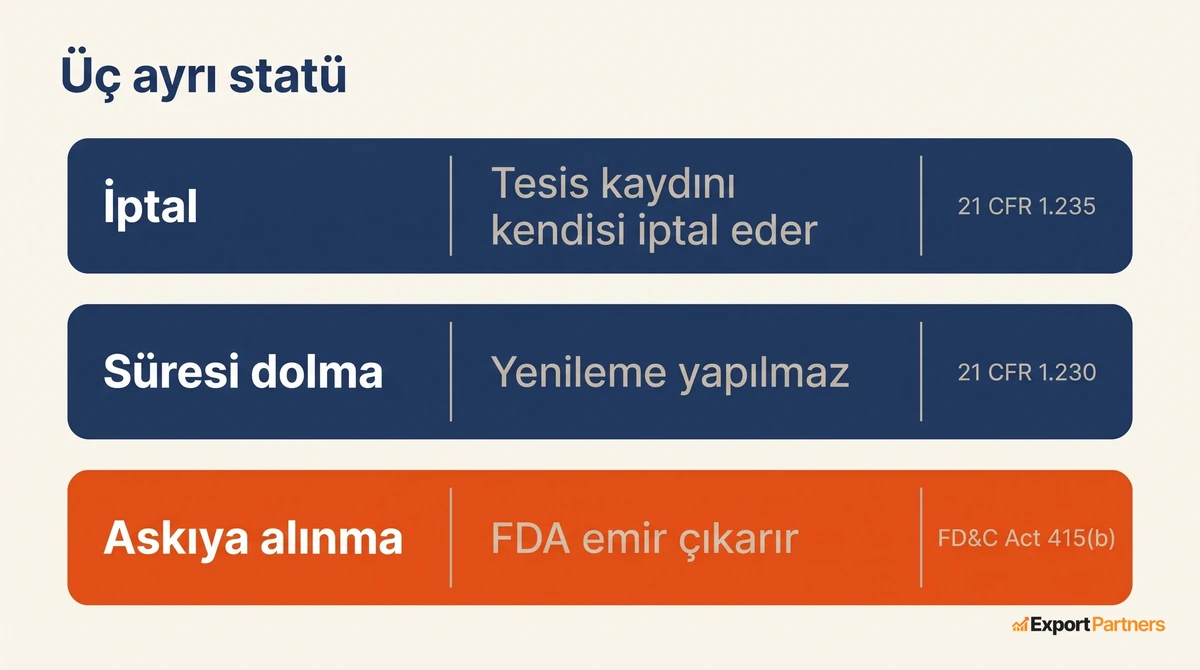
In short: Revocation occurs at the facility’s own request; expiration occurs automatically if the two-year renewal is not completed; and suspension occurs by order of the FDA. The first two are administrative matters, while the third is a procedure the FDA initiates when it identifies a serious potential food safety risk.
| Status | How is it formed? | Reference |
|---|---|---|
| Cancellation | The facility cancels its own registration | 21 CFR 1.235 |
| Expiration | Renewals will not be processed until December 31 of even-numbered years | FD&C Act § 415, 21 CFR § 1.230 |
| Suspension | The FDA issues an order | FD&C Act Section 415(b) |
Under what circumstances is it necessary to cancel the registration?
According to 21 CFR 1.235, the revocation of registration must be completed within 60 calendar days of the occurrence of the event requiring revocation. The regulation lists three examples of such grounds: the facility ceasing operations, discontinuing shipments of food to the U.S., and the facility being transferred to a new owner. Cancellation has been processed electronically since January 4, 2020; however, if the FDA has granted an exemption, the options of mail or fax remain available.
The transfer status is the most commonly overlooked item. When a facility changes hands, the old record must be closed and a new record opened in the new owner’s name. If the old record remains open, an active record remains in the system under the name of a business that no longer exists.
Failure to comply with registration, renewal, update, and cancellation requirements is considered a prohibited act under Section 301(dd) of the FD&C Act. In other words, cancellation is a more appropriate way to close an account than leaving it open.
What happens to my registration if I miss the renewal deadline?
If renewal is not completed by December 31 of an even-numbered year, the registration period is considered to have expired, and the FDA deems the facility to have failed to meet its registration obligation. Since 2026 is an even-numbered year, the renewal window is from October 1 to December 31, 2026. The step-by-step process and checklist are outlined in our FDA registration renewal guide.
What’s happening here is different from a cancellation: the facility isn’t taking any action; the registration is expiring due to the calendar. The result, however, is similar to a cancellation on the shipping side, because in both cases the facility no longer appears as registered.
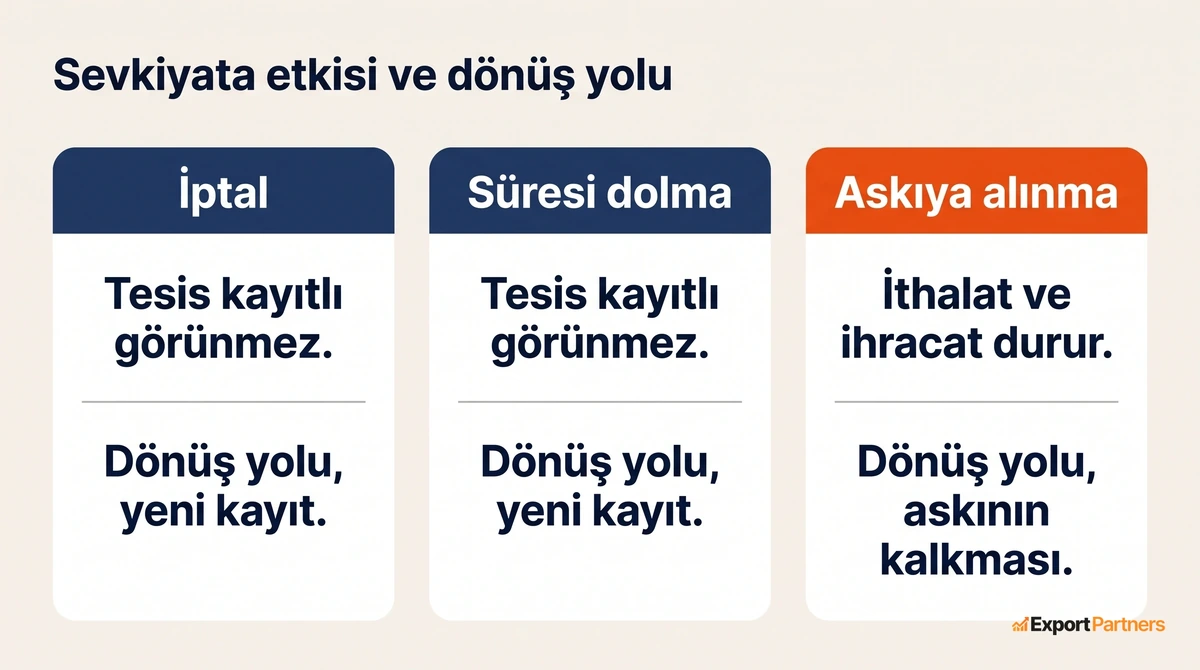
| Status | Impact on shipping | The Way Back |
|---|---|---|
| Cancel | The facility does not appear in the registry but may be subject to inspection at the food entry point | A new registration is made |
| Expiration | The facility does not appear in the registry but may be subject to inspection at the food entry point | A new registration is made |
| Suspension | During the suspension period, food may not be imported from the facility to the U.S., exported, or placed on the market | The FDA needs to reinstate the registration |
What happens to food from unregistered facilities?
If a foreign facility subject to registration is not registered, food originating from that facility and imported into the U.S. or presented for import is held at the point of entry and is not released to the importer, owner, or recipient until the facility completes its registration. Registration can be completed retroactively, but the time that elapses in the meantime results in storage and holding costs for the company.
The regulation published in the Federal Register on September 25, 2025 (90 FR 46045) and effective October 27, 2025, added a time limit here. A 30-calendar-day period was established for submitting facility registration information for a shipment held due to an unregistered facility. The same regulation also established a 10-day deadline for submitting Prior Notice following a rejected or held shipment; details can be found in our Prior Notice guidance.
It’s important to note that even after registration is complete, a shipment may still be subject to inspection. Registration does not guarantee entry; label compliance and inspections at the point of entry remain separate issues. This is explained in detail in our article titled “I Have an FDA Certificate, but My Product Is Held Up at Customs.”
Under what circumstances does the FDA suspend a registration?
Section 415(b) of the FD&C Act grants the FDA the authority to suspend a facility’s registration if there is a reasonable likelihood that the food produced, processed, packaged, or held by the facility could result in serious health consequences for humans or animals. This authority is exercised when the facility caused the situation or was aware of it, or should have been aware of it.
When a suspension order is issued, the registrant is given the opportunity to attend an informal hearing. This hearing is held as soon as possible after the order is issued, and no later than 2 business days; the parties may agree on a different timeframe. The hearing focuses on the steps required to reinstate the registration and the reasons why the suspension should be lifted.
While the suspension is in effect, pursuant to 415(b)(4), no one may import food from that facility into the United States, export it, offer it for export, or place it into commerce within the United States. If the FDA determines, based on the evidence presented, that there are insufficient grounds to maintain the suspension, it reinstates the registration.
This third status should not be discussed in the same context as the first two. Administrative actions such as revocation and expiration are distinct from suspension, which is a separate legal process.
How do you check your registration status?
The registration status can be viewed through the FURLS account used to submit the registration. The FDA does not publish facility registrations on a public screen accessible to everyone; therefore, the only way to check the status is to log in to your own account. If you lose your account information, the first step is to recover it, because both renewals and cancellations are processed through the same account.
At this point, the FDA would like to highlight another issue: third parties that offer to verify your registration status by requesting your registration number, PIN, and FURLS login information are not acting on behalf of the FDA. The FDA recommends protecting this information. Since registration and renewal are free, it makes sense to proceed with caution if you encounter an entity that requests payment in exchange for verification.
Logging into your account once a year to check your registration status, the “US Agent” field, and product categories is a simple habit that helps you catch all three issues early. Doing this check in September—especially as you head into even-numbered years—helps reduce the workload in December.
How do I re-register?
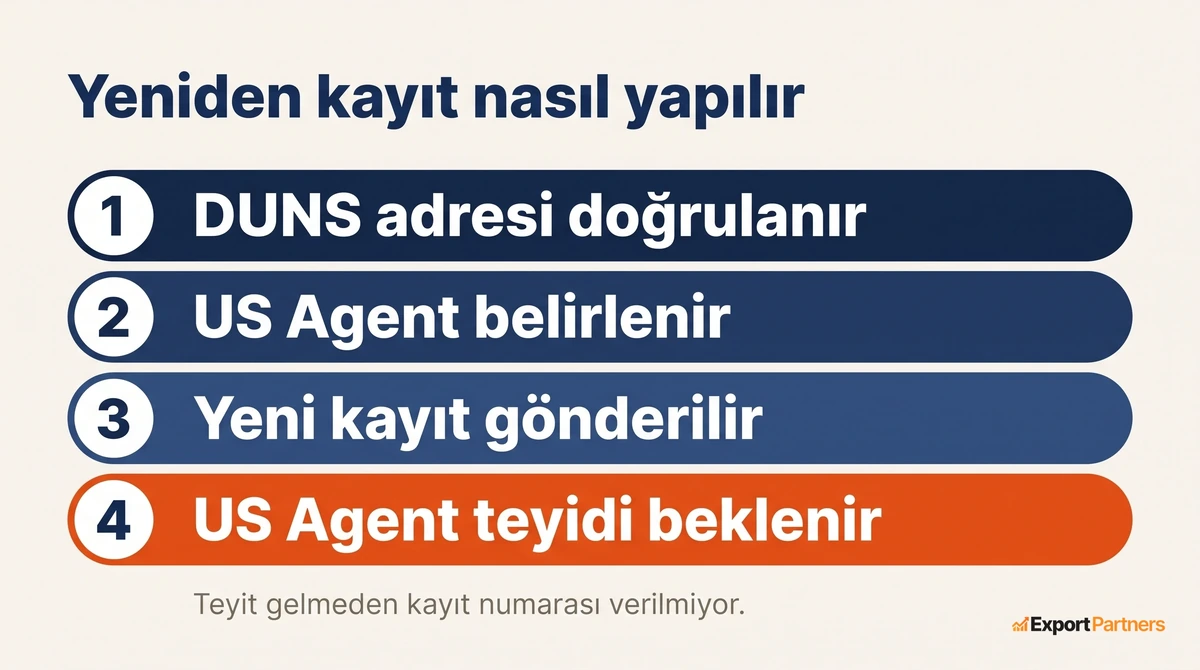
For a facility whose registration has been canceled or has expired, the process involves opening a new registration. The process works the same way as the initial registration: facility information, product categories, the DUNS number as the unique facility identifier, and, for facilities located outside the U.S., US Agent information are entered. Confirmation from the representative is then awaited.
| My Name | What's going on? |
|---|---|
| 1 | The address associated with the DUNS number is being verified to ensure it is current |
| 2 | The U.S. agent is being identified, and the email address of the person who will provide confirmation is being verified |
| 3 | A new record is being sent; product categories are selected based on actual production |
| 4 | Confirmation from the U.S. Agent is pending; a registration number will not be issued until confirmation is received |
| 5 | The new registration number is beginning to be used on shipping documents |
We have detailed the confirmation mechanism on the representative’s side and the procedure to follow in the event of a change in representative in our FDA U.S. Representative Guide. Since the new registration number may differ from the old one, the records held by the importer and customs broker must also be updated.
Frequently Asked Questions
If my FDA registration is revoked, can I re-register?
You can do that. A new registration is created for a canceled or expired registration, and the process works the same way as the initial registration. US Agent confirmation is required again, so having up-to-date agent information speeds up the process.
If my registration period has expired, will I get my old number back?
A new registration must be created to replace an expired one, and this generally means a new registration number. If the old number remains on shipping documents or in the importer’s records, it must be updated.
I sold my business. What should I do about the registration?
Transfer is listed as a reason for revocation in 21 CFR 1.235, and revocation must be completed within 60 calendar days of the occurrence of the grounds for revocation. The new owner files a new registration in their own name. Leaving the old registration open results in an active registration in the name of a business that no longer exists.
I've stopped sending it to the U.S. temporarily—should I cancel the registration?
Ceasing to ship food to the U.S. is listed among the grounds for cancellation in the regulation. However, if you plan to resume shipping in the near future, it may be more practical to keep your registration active and renew it every two years. The decision depends on how long the hiatus will last.
Does a suspended registration automatically become active again?
No. The suspension ends when the FDA reinstates the registration. The FDA makes this decision when it determines, based on the evidence presented, that there are insufficient grounds to continue the suspension.
Conclusion
FDA registration revocation, expiration, and suspension are three distinct statuses. The first occurs upon the facility’s own application and is processed within 60 calendar days; the second occurs automatically on December 31 of even-numbered years; and the third occurs by order of the FDA and is subject to a separate procedure.
For the first two, the process involves opening a new registration, and this process is again subject to US Agent verification. The most practical step is to make sure you don’t miss the 2026 renewal window. Since the rules are subject to change, it makes sense to verify them on fda.gov before proceeding.
You can contact us through our FDA registration and certification services to check your registration status, re-register, or renew your registration.

