
An FDA U.S. Agent is a person residing in the United States or having a place of business there, who is designated by a food facility outside the United States to handle communications with the FDA. This is a required field in the registration process for foreign facilities. The agent serves as the FDA’s primary point of contact in both emergency and routine situations, and the FDA considers any document delivered to the agent to have been delivered to the facility.
In most companies, this field is filled out as a mere formality and then forgotten. However, registration and renewal depend on the representative confirming to the FDA that they have accepted the role. If no confirmation is received, the FDA does not validate the registration and does not issue a registration number. In other words, it’s not enough to list the correct person; that person must also respond to an email in a timely manner.
Below, we discuss exactly what a representative does, how the verification mechanism works, the process followed when a representative changes, and other roles that are often confused with that of a US Agent.
Who is the U.S. representative to the FDA, and what do they do?
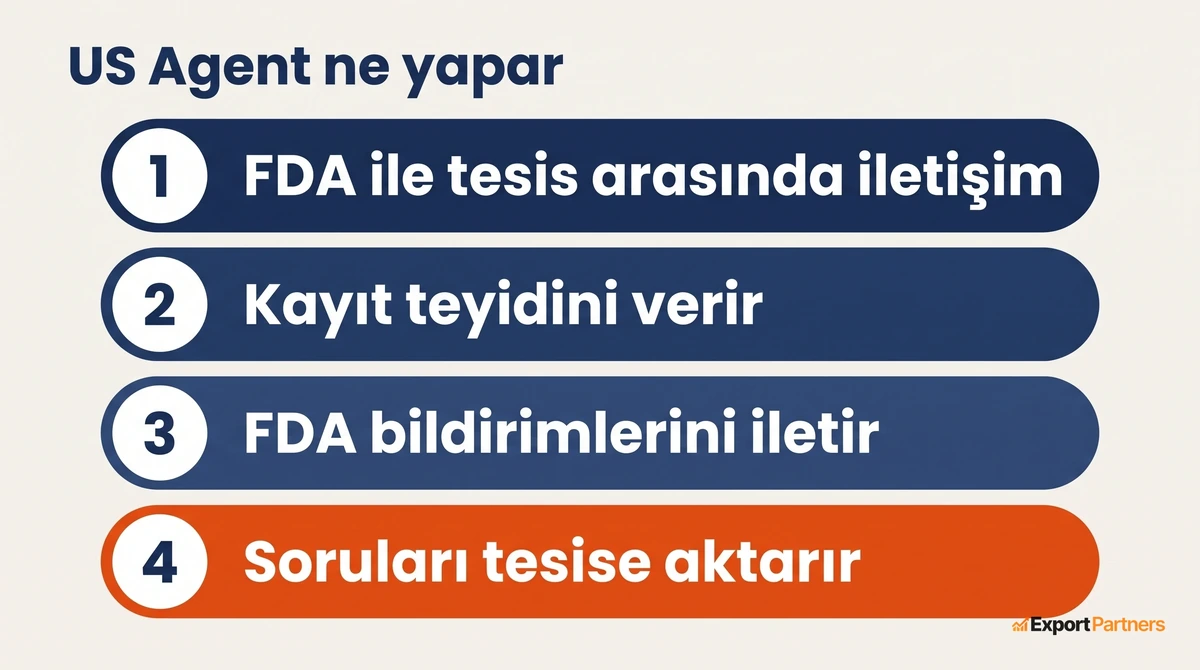
According to the definition in 21 CFR 1.227, a U.S. Agent is a person who resides in the United States or has a place of business in the United States and has been designated by a foreign facility for this purpose. The agent’s role is to serve as a liaison between the FDA and the facility. If no separate emergency contact is specified in the registration, the agent is also the person the FDA will contact in the event of an emergency.
There is one point the regulation emphasizes: The FDA considers the representative’s statements to be those of the facility and treats any information or documentation provided to the representative as having been provided directly to the facility. This means the representative cannot simply act as a mailbox; they become a party speaking on your behalf.
The same regulation also clearly states what does not qualify as a representative. An address where the representative is not physically present—such as a post office box, an answering machine, or a call-forwarding service—is not accepted. In other words, renting an address in the U.S. and listing that address does not satisfy the registration requirement.
Duties Performed by the Representative
In practice, three main tasks stand out: receiving routine correspondence from the FDA and forwarding it to the facility; responding to inquiries regarding the facility’s products or obtaining responses from the facility and forwarding them; and coordinating between the FDA and the facility in planning processes such as inspections. The weight of the role is generally felt when a problem arises.
Why is US Agent confirmation required during renewal?
Pursuant to 21 CFR 1.231(b)(7), the FDA does not verify the registration or renewal of a foreign facility—nor does it issue a registration number—until the person designated as the representative confirms acceptance of that role. The FDA typically carries out this step by sending an email to the representative. The mere submission of the form does not, in and of itself, mean that the renewal is complete.
That is why the renewal period is the crucial moment when the accuracy of the representative’s information is put to the test. The most common delay occurs during the renewal window between October 1 and December 31, 2026; details can be found in our FDA registration renewal guide.
The typical situations in which verification gets stuck are similar: an email address provided two years ago is no longer in use, the message ends up in the spam folder, or the person listed as the representative is unaware that they have been assigned this role. In all three cases, the facility appears to have completed its part of the process, but the registration remains pending.
U.S. Agent Voluntary Identification System (VIS)
The FDA operates a voluntary system that allows representatives to identify themselves in advance. A representative registered with the VIS can view a list of the facilities they represent and manage the verification process more efficiently. While not mandatory, it can simplify the process for parties representing multiple facilities.
What should you do if the representative changes?
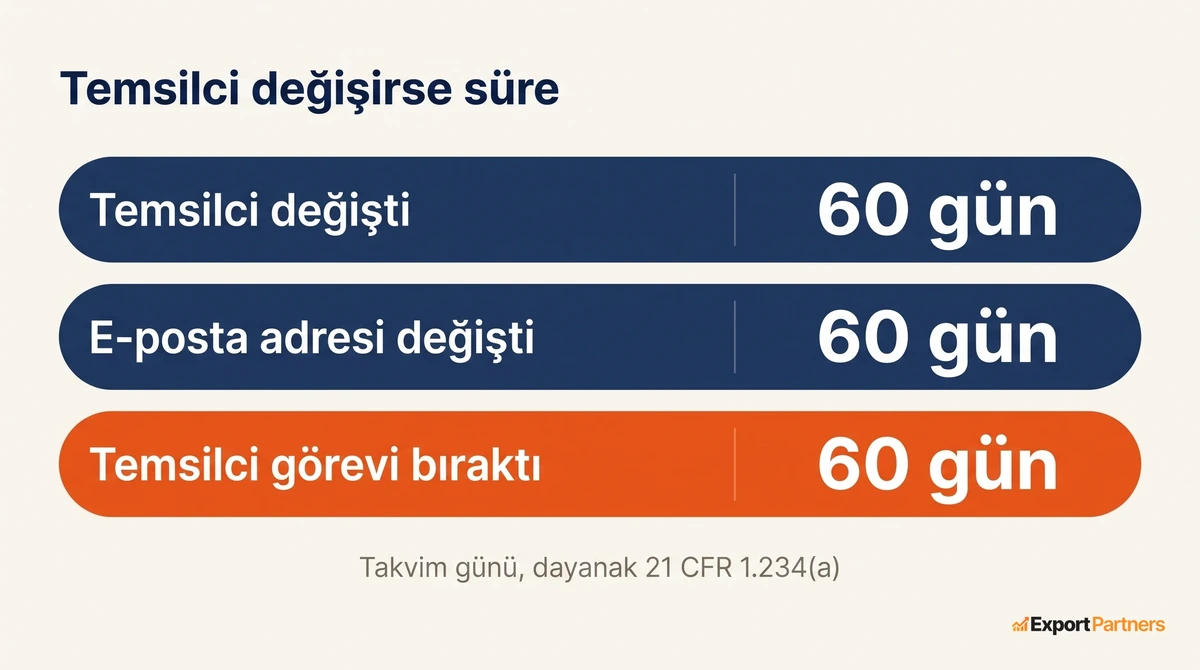
Pursuant to 21 CFR 1.234(a), the registration must be updated within 60 calendar days if there is a change to the required information in the registration. The US Agent’s name, address, phone number, and email address are among this required information. After the update, a confirmation email is also sent to the new agent.
| Status | What's going on? | Duration |
|---|---|---|
| The representative has changed | The US Agent information in the record is being updated; the new agent is providing confirmation | Within 60 calendar days (21 CFR 1.234(a)) |
| The representative's email address has changed | The record is being updated; the address to which the confirmation message is sent is changing | Within 60 calendar days |
| The representative wants to step down | The facility is appointing a new representative and updating the record | Without leaving any spaces |
| The renewal period is approaching | The information is reviewed in September and updated in advance if necessary | Before October 1 |
It’s easier to proceed without cramming the change into the renewal period. When both the renewal and the change of representative are handled simultaneously between October and December, two separate confirmation emails overlap, and it can become unclear which one is expected.
What roles is the US Agent confused with?
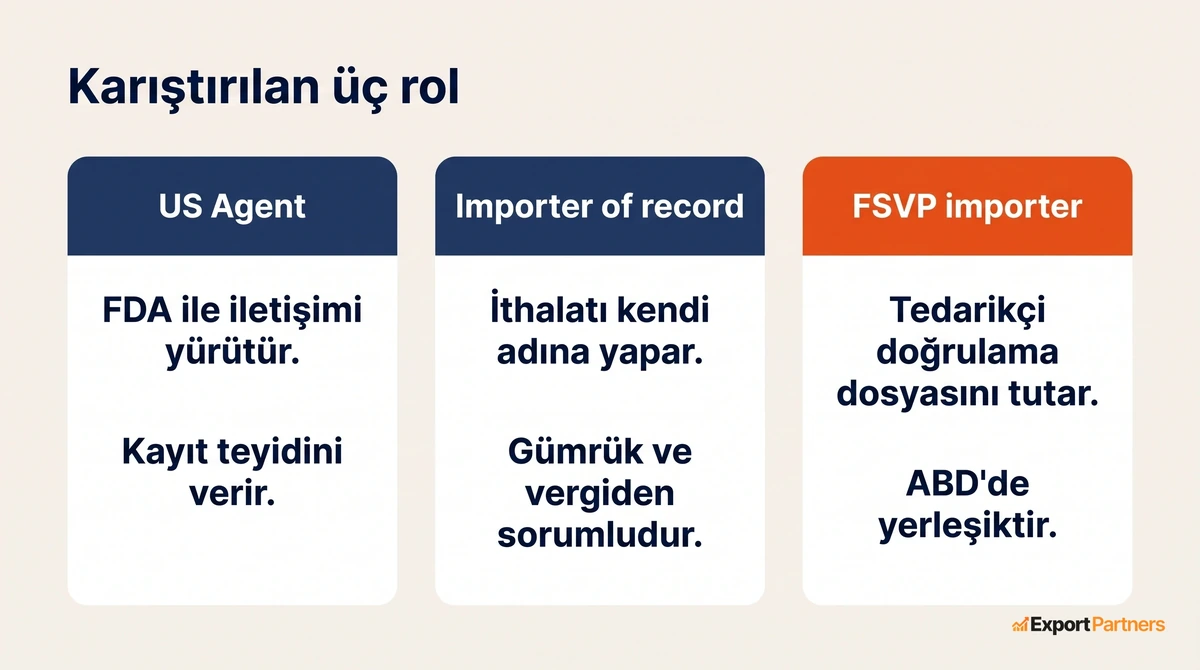
There are four distinct parties involved in exports to the U.S., and they do not necessarily have to be the same person. Confusion usually arises over the question of who is responsible.
| Role | Who | What does it do? |
|---|---|---|
| U.S. Agent | A person or organization based in the United States | Coordinates communication between the FDA and the overseas facility and provides confirmation of registration |
| Importer of Record | The party importing the goods in its own name | Is responsible for customs declarations and taxes |
| FSVP importer | An importer in the U.S. | The supplier maintains the verification file |
| The sender of the Prior Notice | Generally, a customs broker or an importer | Submits the notification on time for every shipment |
If you’ve started your own company in the U.S., these roles may overlap to some extent, but they are still not the same. We’ve covered how the per-shipment notification process works in our FDA Prior Notice guide, and we’ve addressed situations where registration status is compromised in our article on FDA registration revocation and re-registration.
To what extent does a representative's responsibility extend?
The representative’s role is focused on communication and confirmation. The representative is not responsible for product labeling compliance, customs declarations, or import duties; these are the obligations of the importer and the facility. Conversely, any information the FDA wishes to convey to the facility must go through the representative, so the consequences of a message not being relayed fall back on the facility. The notification sent when a product is held at entry also comes through this channel, and since response times are short during the import refusal process, it is crucial that the representative be reachable.
This distinction is useful when drafting a contract. When hiring a representative, clearly defining the scope of services establishes from the outset which correspondence will be forwarded to whom and what the response time will be. When the scope is not specified, people generally assume that the other party is handling it.
There’s one more thing: when the representative changes, correspondence sent to the previous representative does not automatically get forwarded to the new one. The FDA may continue to use the old address until the record is updated. For this reason, having both parties remain on the case simultaneously for a while during the transition can help prevent messages from getting lost.
What should you look for when choosing a representative?
The regulation requires that the representative be based in the U.S., but it does not provide a list of additional qualifications beyond that. In practice, three factors are key: availability, subject matter expertise, and consistency. It makes things easier to have a point of contact who can respond on the same day when needed, rather than just being a number that is called once a year.
Accessibility
Confirmation and information requests sent by the FDA may have time limits. It is essential for the representative to regularly check their email and respond within a reasonable time, even accounting for the time difference.
Mastery of the subject
If the representative is unaware of the facility’s product categories and registration status, they cannot provide a response to the inquiry. Since the FDA considers the representative’s statement to be the facility’s statement, an incorrect or incomplete response may result in a record that must be corrected later.
Continuity
Representation is not a one-time process. When the renewal confirmation every two years, the information requests that come in between, and the coordination of any potential audits are all handled with the same party, the process becomes more predictable.
Frequently Asked Questions
Is an FDA representative in the U.S. required?
A required field for registering food facilities outside the U.S. Facilities located within the U.S. are not required to list a U.S. agent. For facilities located outside the U.S., registration is not verified until confirmation from the representative is received.
Can my importer in the U.S. act as my representative?
It’s possible; the regulation requires the representative to reside in the U.S. or have a place of business there, but it does not require them to be a separate company. The key point to note here is that the roles should not be mixed. Even if your importer also serves as your representative, the FSVP filing and the customs declaration remain separate obligations.
What happens if the representative doesn't confirm?
The FDA does not confirm the registration or renewal and does not provide the registration number. In this case, since the facility does not appear to be registered, issues may arise on the shipping side. If confirmation is provided later, the process continues from where it left off.
Can a representative oversee more than one facility?
It can track this. In this case, the FDA’s voluntary identification system (VIS) can make it easier for the representative to track which facilities they are designated for. As the number of facilities increases, tracking confirmation correspondence also requires a systematic approach.
Is the representative obtaining FDA approval?
No. The FDA does not approve food facilities; it registers them. Therefore, there is no approval or license required for the representative either. The representative is not authorized by the FDA but is appointed by the facility and reported to the FDA.
How much is the agent fee?
There is no fee charged by the FDA for registration as a representative; registration and renewal are also free. The amount paid represents the service fee charged by the party acting as the representative and varies depending on the provider. When budgeting for this expense, it is more realistic to consider it in terms of a two-year renewal cycle rather than an annual one.
Conclusion
The U.S. FDA representative is the one line on the registration form that causes the most delays in the process. Registration is not validated until confirmation is received; a change in representative must be reported within 60 calendar days; and the FDA considers the representative’s word to be that of the facility.
As the renewal period approaches, the most practical step is to verify that the representative is still in good standing and that their email address in the system is active. Since regulations may change, it makes sense to confirm this on fda.gov before proceeding.
You can contact us through our FDA registration and documentation services for representation, registration verification, or renewal.

