
Amazon FBA cash flow is the topic that manufacturers entering the U.S. market talk about the least but struggle with the most in practice. The product has been chosen correctly, the listing is ready, the ads are running, and sales are coming in. Despite this, at some point, there’s no money left in the account, and inventory can’t be restocked just as sales are picking up.
The reason is usually not profitability, but timing. There are months between making money on Amazon and actually receiving that money. The time between the day you pay for production and the day the proceeds from that product are deposited into your bank account is much longer than most companies initially anticipate. You can also check out our article titled “Amazon Product Liability Insurance: Now a Requirement,” which goes into more detail on this topic.
A payment rule that took effect on March 12, 2026, for U.S. accounts widened this gap even further. Below, we first break down, item by item, where the money comes from, and then use an example calculation to illustrate the mechanism on the return side and how many days the cycle actually takes.
Why is cash flow more important than profit in Amazon FBA?
Calculating the profit margin per unit in Excel is easy. You subtract the product cost, Amazon commission, FBA fees, and advertising share; what’s left is the profit. We explained in detail how to set up these line items in our Amazon private label starter guide. Even if the calculation is correct, it can still put the company in a difficult position, because profit is a ratio, while cash flow is a timeline.
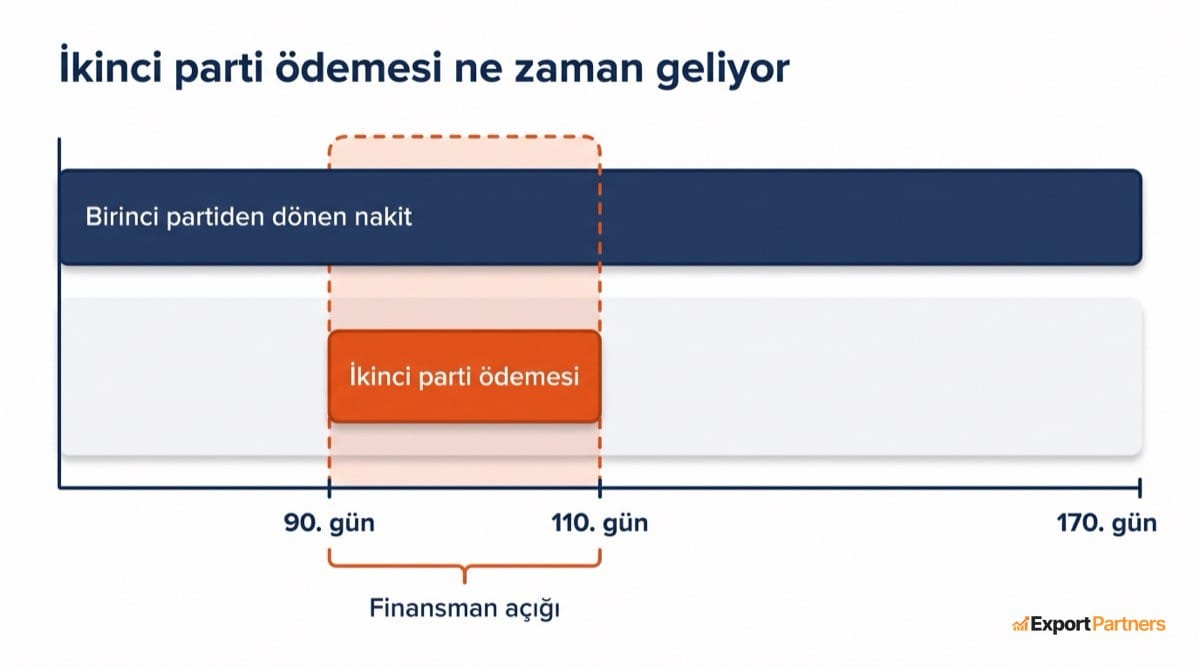
Even with a profitable product, the following situation can arise: by the time the payment is due for the second production run, the funds from the sale of the first batch have not yet been released. The product has been sold, a profit has been made, but the money is still in transit. At this point, either inventory runs out or external financing must be sought.
Running out of stock on Amazon doesn’t just mean losing that day’s sales. Since the listing’s sales rate drops, its organic ranking also falls, and it usually takes a few weeks to regain your previous ranking once inventory is restocked. In other words, cash flow planning is actually part of ranking strategy.
Expense Categories
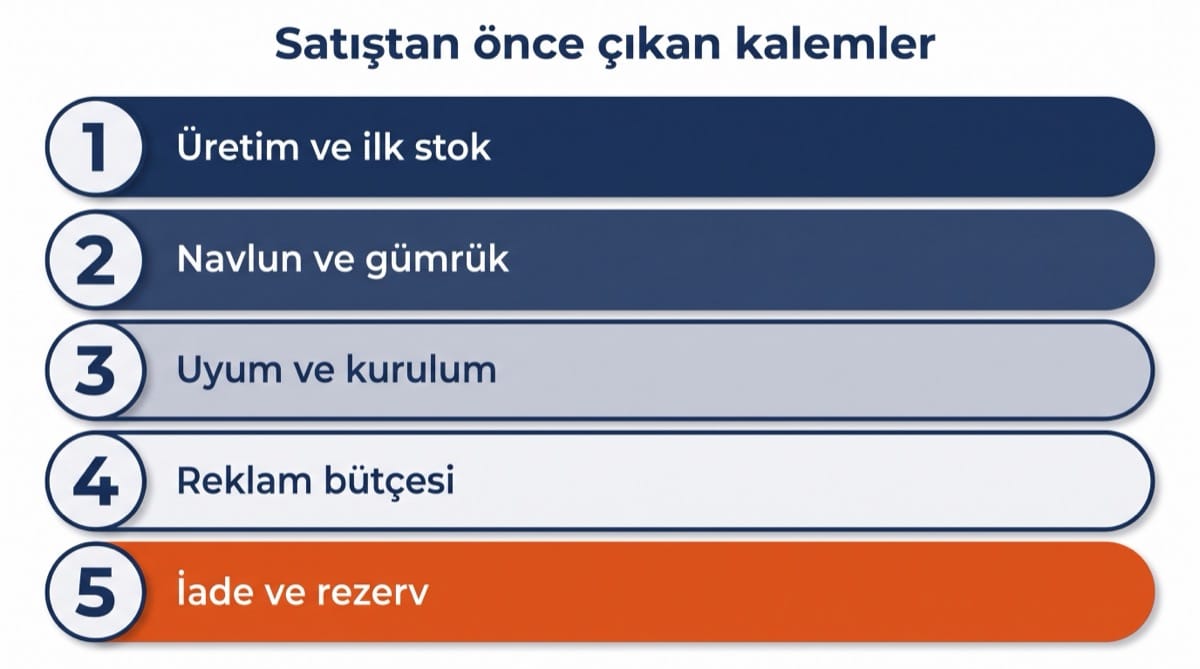
At a company in the U.S. that operates under a private label, cash flows out well before sales are made and from multiple sources.
Production and Initial Inventory
This is usually the biggest expense. Manufacturers often require payment in full or a partial down payment; even if they offer credit terms, they may not do so for the first order. While the quantity of the first batch varies depending on the product category, it’s important to strike a balance here, as keeping the order quantity low increases the unit cost.
Freight, customs, and warehouse intake
When shipping to the U.S. by sea, freight, customs clearance, and inland transportation are listed as separate line items. Import duties and, if applicable, inspection fees are added to these costs. Depending on the product category, additional documentation and cost items may also arise during U.S. and Canadian customs processes. In our article on U.S. customs duties for Amazon, we detailed the composition of these duties for products originating in Turkey as of 2026.
Compatibility and Setup Items
In sectors such as food, dietary supplements, and cosmetics, the FDA registration and certification process, as well as applications related to U.S. company formation and brand awareness, are expenses paid prior to sales. Since these are one-time expenses, they should be listed as a separate line item in the first year’s cash flow plan.
Advertising budget
During the launch period, ad spend precedes sales and generally peaks in the first few weeks. Campaign design and bid management directly impact how much of this spend will be recouped; details can be found in our Amazon PPC ad management guide.
Refund and Reservation Fee
Amazon deducts returns from the seller's account and also holds a reserve in the account. This reserve is an amount set aside to cover potential returns and disputes. In other words, not all of the balance shown on the screen is available for withdrawal.
Where the money comes back: The Amazon payment cycle
Amazon does not pay the sales proceeds immediately. Three separate mechanisms are involved.
14-day billing cycle
Payments for professional seller accounts are processed in two-week periods. After the period closes, the amount is initiated for bank transfer, and it typically takes another 3 to 5 business days to be credited to the account. In other words, the payment processing alone can take up to 20 days.
The DD+7 Rule and the March 12, 2026, Amendment
This is the most important development of late. Amazon has shifted the payment release date from the shipment date to the delivery date. Under the new rule, the amount is released 7 days after the order is delivered to the recipient. In the industry, this rule is known as DD+7.
The program began for European accounts in the fall of 2025 and went into effect for U.S. accounts as of March 12, 2026, covering the vast majority of seller accounts. The idea is to give buyers time to inspect the product and return it.
The practical effect is this: the timer, which used to start the moment you shipped the package, now begins after the product reaches the customer’s doorstep. While this difference may seem like just a few days for a single order, because it applies to hundreds of orders at the same time, it permanently increases the pending amount in the account. Companies that don’t factor this rule into their calculations see a lower available balance for the same revenue and generally mistake this for an error.
Hold and reserve levels for new accounts
For newly opened seller accounts, it may take longer for the first payment to be received; there may be a wait of nearly 30 days during the initial period. As the account history builds up and the order defect rate remains low, the reserve rate is gradually reduced. In other words, the situation in the first few months is not permanent.
How many days does the cycle last: a sample calculation
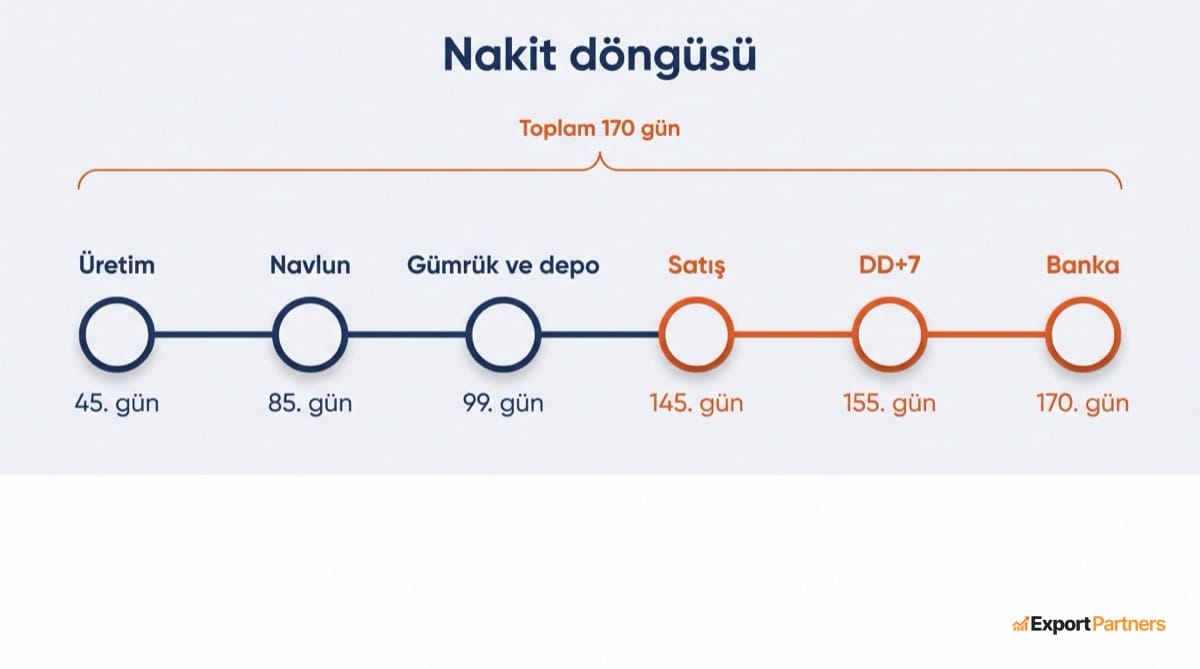
The table below shows a typical cycle at a company that ships to the U.S. by sea. The figures may vary depending on the product group, manufacturer, and season; the purpose here is to illustrate the sequence and order of magnitude.
| Stage | Typical duration | Cumulative |
|---|---|---|
| Payment for Production and Production | 30–45 days | Day 45 |
| Freight and maritime transport | 30–40 days | Day 85 |
| Customs Clearance and FBA Warehouse Receipt | 7–14 days | Day 99 |
| Inventory Sales (Average Turnover) | 30–60 days | Day 145 |
| Delivery and DD+7 hold | 7–12 days | Day 155 |
| Statement Date and Bank Transfer | 14–20 days | Day 170 |
In other words, there can be a gap of more than five months between the day you pay for production and the day the proceeds from the final product of that batch are credited to your account. The proceeds from the first sales come in sooner, of course, but it takes that long for the entire batch to be converted into cash.
The critical point is this: the date by which you must pay for the second production run generally falls between the 90th and 110th days. By that date, the cash returned from the first production run does not cover the full amount you’ve spent. You need to cover the difference with working capital, and this is the item most often overlooked in planning.
Practical ways to shorten the cycle
You can't change the entire calendar, but it is possible to make a real difference in a few areas.
- Plan the first batch to be small and the second batch to be early. A large initial order lowers the unit cost but ties up cash for a long time. During the launch phase, speed can be more valuable than unit cost.
- Discuss the payment terms with the manufacturer. Even a 30-day payment term cuts a month off the most expensive part of the cycle. It might be difficult for the first order, but it can be put on the table for the second order.
- For the first shipment, consider the air freight option. Although the freight cost per unit is higher, it brings the launch forward and accelerates cash flow by reducing the 30-day sea transit time to just a few days. The decision hinges on comparing the time saved against the additional cost per unit.
- Measure your inventory turnover rate—don’t guess it. Setting a reorder point based on weekly sales volume reduces both stockouts and excess cash tied up in inventory.
- Scale your advertising budget based on sales velocity. Keeping it high during the launch and then proceeding cautiously based on your target ACoS once the product has gained traction helps alleviate pressure on cash flow.
12 Mart 2026 değişikliği: ödeme artık teslimata bağlı
Amazon, 12 Mart 2026 itibarıyla ABD ve Kanada hesaplarında ödeme uygunluğunu kargo çıkışından teslimata bağladı. Deferred Transactions adıyla raporlanan bu değişiklik hem FBA hem FBM satıcılarını kapsıyor; Avrupa tarafında benzer uygulama daha önce devreye alınmıştı.
Pratik sonucu, aynı satış hacminde daha geç dönen bir nakit. FBA’de ürün Amazon deposundan çıktığı için teslim süresi kısa, tipik olarak iki gün civarında. FBM’de kargo süresi satıcının seçtiği yönteme bağlı ve beş günü bulabiliyor; bu da toplam süreyi belirgin biçimde uzatıyor. Kendi hesabınızdaki karşılığını Seller Central üzerinden Payments bölümünden görebilirsiniz.
Rezerv tutar ile DD+7 aynı şey değil
DD+7 her siparişe uygulanan standart bekleme süresi. Account Level Reserve ise Amazon’un hesap bazında tuttuğu ek bakiye ve genelde performans, iade oranı ya da yeni hesap durumuyla ilişkilendiriliyor. Bir hesapta ikisi aynı anda çalışabiliyor ve rapor ekranında ayrı satırlarda görünüyor. “Para neden gelmedi” sorusunun cevabı için önce hangi kalemin tuttuğuna bakmak gerekiyor.
Parayı geciktiren iki kalem: iade penceresi ve gider zamanlaması
ABD’de çoğu kategoride alıcının iade süresi otuz gün. Para size teslimattan yaklaşık iki hafta sonra geçse de iade riski o tarihte bitmiyor; iade gerçekleştiğinde tutar sonraki ödeme döneminden düşülüyor. İade oranı yüksek kategorilerde gelen tutarın bir kısmını sonraki dönemin iade düşümü için ayırmak daha güvenli bir yaklaşım oluyor.
Gider tarafında asıl mesele zamanlama uyumsuzluğu. Aylık depolama ücreti bir sonraki ayın ilk yarısında hesaba yansıyor; uzun süre kalan stok için ek kalemler devreye girebiliyor. Reklam harcaması ise oluştuğu anda birikiyor. Yani reklam gideri satışın olduğu gün doğuyor, o satıştan gelen para ise yaklaşık iki hafta sonra. Kampanya bütçesini agresif artırdığınız bir haftada, o haftanın nakdi henüz hesapta olmuyor.
Türkiye’den satarken eklenen iki gecikme
Birincisi ABD hesabından Türkiye’ye ya da ABD şirketinizin hesabına yapılan aktarımın süresi. İkincisi kur: satış ile aktarım arasında geçen sürede kur değişebiliyor ve maliyet hesabı TL tarafında kayabiliyor.
Bu ikisi Amazon’un takvimine ekleniyor, onun yerine geçmiyor. ABD tarafında on iki gün olan bir süre, Türkiye tarafında planlama yapılırken daha uzun düşünülüyor.
Erken ödeme seçenekleri işe yarar mı
Amazon’un talep üzerine ödeme özelliği duruyor ama artık yalnızca DD+7 süresini tamamlamış tutarlardan çekim yapıyor. Düğme yerinde, arkasındaki kullanılabilir bakiye küçüldü; beklemedeki tutarı bu yolla öne çekmek mümkün görünmüyor.
Piyasada satıcı alacağını erken ödeyen finansman şirketleri var. Bunlar gerçek bir nakit sorununu çözebiliyor, ancak maliyetleri genelde ürün marjı üzerinden değil alacağın tamamı üzerinden hesaplanıyor. Kullanmadan önce yıllık maliyeti kendi marjınızla karşılaştırmak gerekiyor.
Three Common Mistakes in Planning
First, mistaking the profit margin for cash. A product with a 30 percent margin is profitable, but that profit may not be available when you need it to finance the next batch.
Second, mistaking the balance on the Amazon dashboard for the withdrawable balance. Amounts on hold due to reserves and DD+7 appear there but are not yet available.
Third, mixing one-time setup costs into operating expenses. FDA registration, trademark applications, and company formation should be listed as separate line items in the first year’s cash flow statement; otherwise, profitability appears better than it actually is because it’s based on product-level figures.
Frequently Asked Questions
How often exactly are Amazon payments made?
Payments for Professional Seller accounts are processed in 14-day cycles. After the cycle closes, it may take an additional 3 to 5 business days for the bank transfer to be credited to the account.
Does the DD+7 rule apply to my account as well?
This rule applies to the vast majority of seller accounts. Amazon may apply different reservation timing to accounts with a long history and a low defect rate, but it’s safer not to plan on this as a given.
When will my first payment be credited to my new account?
For newly opened accounts, there may be a wait of nearly 30 days for the first payment. In subsequent periods, the standard 14-day cycle takes effect.
Will the reserve ratio decrease?
As the account history builds up and the order defect rate remains low, the reserve may gradually decrease. The situation in the first few months is not permanent.
How much capital should be set aside for the first batch?
It wouldn’t be accurate to give a single figure, because the product group, target price, and order quantity are all determining factors. A sound approach is to set aside a separate line item for the second batch in addition to the cost of the first batch. Cash flow issues generally arise not with the first batch, but on the payment due date for the second batch.
What happens to my ranking if I run out of stock?
When inventory runs out, sales slow down, causing the organic ranking to drop. It can usually take a few weeks to return to the previous ranking once inventory is restocked, so it’s important to determine the reorder point early.
Conclusion
Amazon FBA cash flow is separate from profitability calculations and requires even stricter discipline. The time from paying for production to receiving funds in the bank account can take up to five months, and the DD+7 rule, which took effect on March 12, 2026, has extended this timeline somewhat further. Reviewing the table from the beginning helps prevent both running out of stock and tying up more cash than necessary.
If you’d like to develop a timeline for inventory, launch, and advertising—along with the financial aspects—as part of your plan to enter the U.S. market, we can review it together using our framework for Amazon launches and advertising. We can also clarify within the same plan how customs and compliance requirements fit into the timeline based on your product category.
Son güncelleme: 10 Eylül 2026

