
Your Amazon U.S. customs duty calculation has changed as of July 24, 2026. An additional 12.5 percent customs duty has begun to be applied to products originating in Turkey under Section 301. The decision was announced by the USTR on the evening of July 23, 2026. Categories in which Turkish sellers are heavily represented—such as food, cosmetics, dietary supplements, and home textiles—are not included on the general exemption list for this duty.
The 15 percent rate that is still being discussed in the market is no longer in effect. That tier was completely eliminated in February 2026 following a Supreme Court ruling. The only additional tier specific to Turkey that is currently in effect is the 12.5 percent rate under Section 301.
In this article, we explained how the new rate is applied to your FBA cost table, which products are covered, which sales model is actually affected by the removal of the de minimis exemption, and the textile quota that will be finalized on September 1.
What exactly is the U.S. customs duty on Amazon?
Amazon U.S. customs duties are the total amount of taxes paid when your product clears U.S. customs. Amazon does not collect this tax; it is paid by the importer of record. For FBA shipments, this is typically you or your importer in the U.S.
The total duty is not composed of a single rate. Additional layers are added to the base duty (MFN) determined by the product’s HTS code, depending on the country and policy. Effective July 24, 2026, one of these layers for products originating in Turkey is the Section 301 forced labor duty.
The decision was made pursuant to the final action of the U.S. Trade Representative dated July 23, 2026, and was published in the Federal Register on July 28, 2026 (document number 2026-15181). The customs enforcement directive is contained in CBP message number CSMS 69326983.
Why is the 15 percent figure no longer accurate?
The 15 percent rate that Turkish exporters remembered was the reciprocal tariff tier imposed under IEEPA authority. On February 20, 2026, the Supreme Court ruled that the IEEPA did not grant the president the authority to impose additional customs duties. An executive order (EO 14389) issued the same day repealed all additional duties based on that authority.
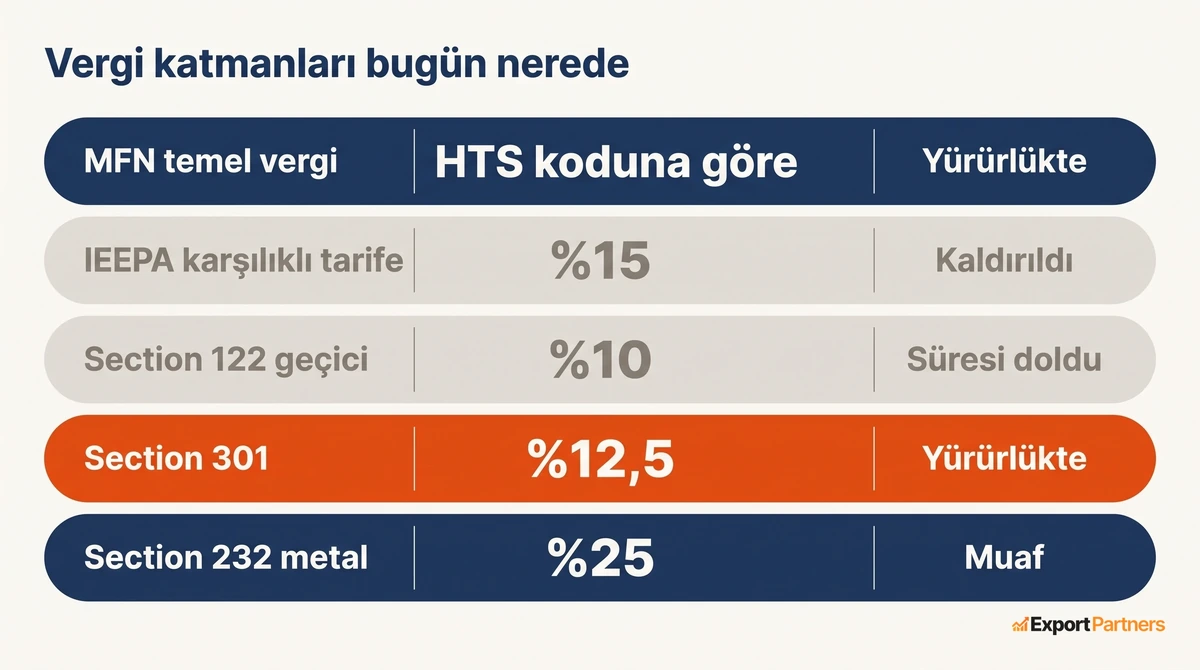
Instead, a temporary 10 percent additional import duty was imposed under Section 122 of the Trade Act. The statutory term of this regulation is 150 days, ending on July 24, 2026. The text states that this period can only be extended by a resolution of Congress. No regulation has been published regarding an extension, nor is there a separate announcement confirming that it has expired.
Practical takeaway: The 12.5% rate under Section 301 is definitive and in effect. You’ll need to confirm with your customs broker whether any other general tariff tier applies, based on your shipment date. The most common mistake is adding the 12.5% to the 15% rate, under the assumption that the 15% rate is still in effect. There is no such combined rate.
| Layer | Ratio | Status |
|---|---|---|
| MFN (base tax) | It depends on the HTS code | In effect |
| IEEPA Reciprocal Tariff | %15 | It was discontinued on February 20, 2026 |
| Section 122: Temporary Additional Tax | %10 | The 150-day period expired on July 24, 2026; the current status must be confirmed |
| Section 301: Forced Labor | %12,5 | It took effect on July 24, 2026, and remains in effect |
| Section 232 metal derivatives | 25% base | In effect, exempt from Section 301 |
Why was this tax imposed?
The Section 301 investigation targets a gap in Turkey’s legislation: the absence of a regulation prohibiting the import of goods produced through forced labor. The decision is not based on allegations of forced labor in Turkish production.
This distinction may be important in your communication with customers. If your U.S. buyer misreads the news, they might conclude that “Turkish goods have been classified as products of forced labor.” Accurately explaining the reasoning behind this is a step toward protecting your business relationship.
There are 60 economies included in the scope. Of these, 17 are at the 10 percent tier because they have made a commitment to ban imports. Turkey is currently in the top tier, at 12.5 percent. Theoretically, there is a possibility that this rate could decrease if Turkey makes a commitment, but no such development has been announced.
Which products are covered, and which are exempt?
The general exemptions published by CBP are a limited list: civil aviation products, pharmaceuticals, metals and their derivatives covered under Section 232, humanitarian aid donations, and informational materials. Food, cosmetics, dietary supplements, and home textiles are not included on this list.
Conversely, the annexes to the decision (Annex I and Annex II, Part A) also contain product-specific exemptions. These annexes include criteria such as “products that cannot be produced in sufficient quantities in the U.S.” and consist of a line-by-line list of HTS codes.
The practical takeaway is this: just because your category isn’t included in the general exemption doesn’t mean your specific HTS code is covered. It’s safer to check your own code against the supplementary lists one by one rather than making assumptions.
There is also a transitional exemption. Goods loaded before July 24, 2026, and entered into the U.S. before July 28 are exempt from this tax.
How is your landed cost calculation changing?
The formula is simple: the MFN rate plus 12.5 percent of the CIF value. On the customs declaration, the Section 301 duty is listed under Chapter 99, before Section 232.
If you are using a free trade zone (FTZ), there is one point to keep in mind: the goods must enter with “privileged foreign status.” For imports covered under Chapter 98, the Section 301 duty does not apply.
The table below shows the standalone effect of the Section 301 duty based on a CIF value of $10,000. The MFN rate was set at 4% as an example; the rate for your specific tariff code will be different.
| Pencil | Amount |
|---|---|
| CIF value | 10.000 USD |
| MFN (e.g., 4%) | 400 USD |
| Section 301 (12.5%) | 1.250 USD |
| The sum of these two items | 1.650 USD |
| Per unit (batch of 1,000) | 1,65 USD |
In this example, the Section 301 duty alone adds $1.25 to the unit cost. Your product’s own MFN rate is added on top of this, so the actual total varies depending on your specific tariff code. Providing a single total figure would be misleading. This amount is paid upfront when the goods enter the U.S., while sales revenue is received weeks later. For more on the tax’s impact on cash flow, see our article on Amazon FBA cash flow and payment cycles.
Which sales model is affected by the de minimis exemption?
The $800 de minimis exemption has been suspended for all countries since August 29, 2025. Two CBP regulations published on June 24, 2026, made the suspension indefinite and shifted its legal basis from a presidential decree to a statutory provision. On July 1, 2027, the exemption will be completely removed from the text of the law.
There is no separate exception for Turkey. No distinction is made between countries in this regard.
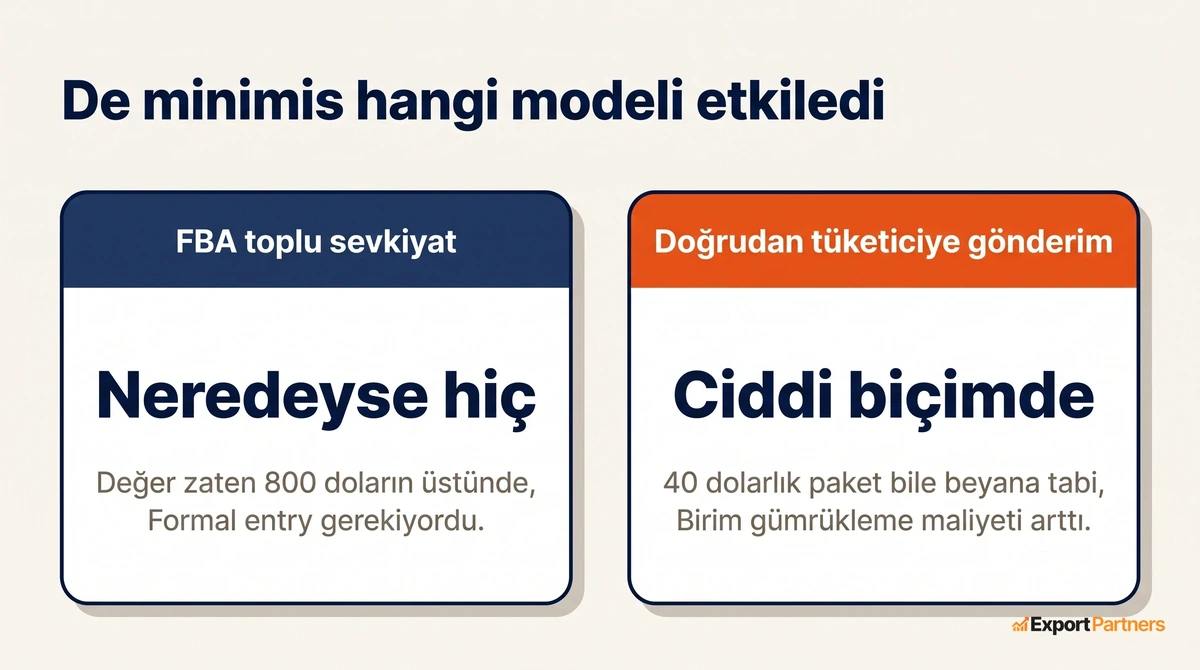
The real issue is this: this change affects the two sales models very differently, and most sellers are worried about the wrong one.
| Model | Was he affected? | Why? |
|---|---|---|
| FBA Bulk Shipments | Almost none | Its value was already well over $800, so it required formal entry. The de minimis rule never applied to this model. |
| Direct shipping to the consumer | Seriously | Even a $40 package is now subject to customs declaration and taxes. The customs clearance cost per unit and delivery time have increased |
In other words, if you’re using the FBA model, the de minimis threshold didn’t have a direct impact on your cost structure. If you’re shipping individually from your own website, Etsy, or via FBM, the impact can be significant.
There is also a common misconception: it is claimed that goods subject to Sections 301 and 232 are already ineligible for the de minimis exemption. This is not true. Prior to the suspension, these goods were also eligible for the exemption, and CBP had determined in its draft rule that the majority of low-value shipments were spared additional duties as a result.
Entry Type 86 has been eliminated. Entries valued at $2,500 or less are now processed as informal entries through ACE.
How should you set your FBA prices?
A hasty price increase isn’t always the right move. On Amazon, price changes affect sales velocity, and sales velocity, in turn, affects organic rankings. Risking your ranking for a two-and-a-half-point increase in costs may not be worth it.
A more logical approach might be as follows: First, determine which tax regime applies to your current inventory. Inventory received before July 24 remains at its original cost. Changing the price while waiting for the new shipment will unnecessarily increase or decrease the margin on the goods you currently have on hand.
The second step is to look at the cost per conversion in your PPC budget. A two-and-a-half-point improvement on the advertising side can often offset the increase on the customs side.
If you’d like to thoroughly review the cost structure of your Amazon operations, we’ll set up this account together as part of our Amazon consulting services.
Textile quota to be finalized on September 1
A Presidential Memorandum issued on July 28, 2026, directs the U.S. Trade Representative to establish tariff quotas for certain textile and apparel imports and to assess their feasibility by September 1, 2026.
The scope of this quota has not yet been announced. It is unclear whether it will include home textiles (such as towels, bathrobes, and bedding—items under Chapter 63). If you sell products in these categories, this is the most important development to watch.
Two topics that are often confused
First is the UFLPA. This is not a tax, but rather an import ban and a rebuttable presumption mechanism. All of the companies added to the list with the August 2026 update are located in China, and there are no Turkish companies on the list.
Second, the WRO and Finding decisions. Turkey is not on CBP’s active list. Turkmenistan is on the list, and while this country is referred to as “Turkmenistan” in English-language texts, it is sometimes confused with Turkey in Turkish-language content.
What should I do now?
We recommend following these three steps in order. First, check your HTS code against the annexes to the decision. Next, identify the date your inventory was received. Finally, recalculate the pricing.
If you have shipments that entered the U.S. between February and July 2026, refund processes related to expired tiers may be on the agenda. This matter directly concerns your U.S. importer, so it would be helpful to speak with them.
For classification and declaration processes at customs, please refer to our U.S. and Canadian customs services. If your product falls under the food or cosmetics category, you must complete the registration steps outlined in our article on “Selling Cosmetics in the U.S. on Amazon and MoCRA Compliance” before tax calculation. If the registration process is incomplete, your product may be held at the border before customs clearance; we explain how this process works in our FDA Import Refusal Guide.
Frequently Asked Questions
Is Amazon collecting this tax from me?
No. Customs duties are paid to U.S. Customs by the importer of record. For FBA shipments, this is typically you or your importer in the U.S. The fees Amazon charges are the referral fee and FBA fees, which are separate.
Is the 12.5 percent rate applied uniformly to every product?
The rate for products originating in Turkey is 12.5 percent. However, the appendices to the Federal Register notice dated July 28, 2026, include product-specific exemptions, and metal products covered under Section 232 are exempt from this duty. The exempted items are grouped under tariff heading 9903.05.87 and can be tracked via the list published by CBP. You will need to check your own HTS code.
Does this tax apply to my old inventory as well?
Goods loaded before July 24, 2026, and entered into the U.S. before July 28 are exempt. Your inventory currently held in a U.S. warehouse has already been taxed under the regulations in effect on the date of entry.
Is this rate permanent?
Under Section 301, the rate is contingent on the relevant country’s commitment to impose an import ban on goods produced through forced labor. The 17 economies that have made such a commitment are at the 10 percent tier. Since no such development has been announced regarding Turkey, it would be more prudent to base current planning on a rate of 12.5 percent.
Will the $800 exemption return?
The suspension is indefinite, and the exemption can only be reinstated if CBP publishes a notice in the Federal Register. Additionally, the exemption will be removed from the text of the law on July 1, 2027. After that date, it cannot be reinstated by an administrative decision; a new law would be required. It is safer to plan on the assumption that this is a permanent change.
Have Turkish goods been banned in the U.S.?
No. This is an additional tax, not an import ban. There are no decisions regarding Turkey on CBP’s active WRO and Finding lists, and no Turkish companies are listed on the UFLPA Entity List.
Conclusion
The change in U.S. customs duties on Amazon isn't as severe as it appears in the headlines. The effective increase is two and a half percentage points and is manageable for most private-label products.
The real risk is planning based on incorrect figures. A cost breakdown based on 15 percent no longer reflects reality. Verifying your HTS code, categorizing your inventory receipts by date, and monitoring the textile quota decision on September 1 are the three concrete steps for the coming period.
The rates and dates in this article were compiled from sources such as the Federal Register, the U.S. Trade Representative, and CBP. Trade policy regulations are updated frequently; we recommend that you verify the current status before making a decision regarding your shipment.
Last updated: August 30, 2026

